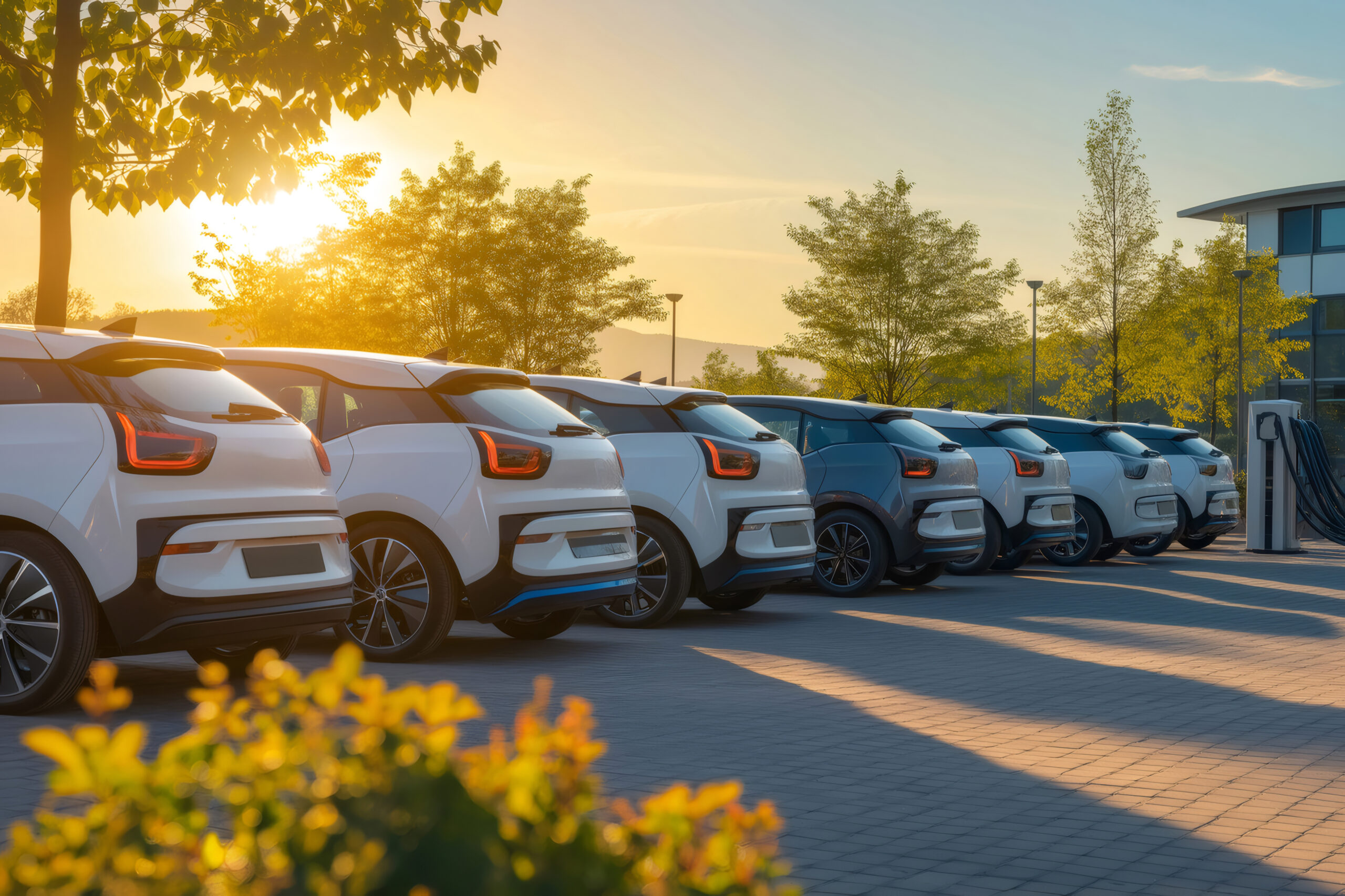
But look past the policy debate and the commercial picture could not be clearer: electric vehicles are taking over UK fleets at pace, running costs are falling, global businesses are committing at scale, and government funding to support the infrastructure shift is available today.
For fleet managers, operations directors and CFOs still weighing the timing of their transition, this is what the latest data actually says.
According to the Society of Motor Manufacturers and Traders (SMMT), battery electric vehicles took a 27.5% share of the new car market in July 2026, up 44.5% compared with July 2025. It was a record volume for the month.
Fleets are driving this growth. The SMMT reports that fleet and business registrations accounted for 63% of all new car registrations in July, with year-to-date fleet registrations up 7.9% on 2025. More than three-quarters of a million new cars have been registered to fleet and business in the first seven months of 2026 alone.
Independent research organisation New Automotive adds further context: for the second consecutive month, BEV sales have outpaced the ZEV mandate trajectory. The effective market-wide target for 2026, after accounting for scheme flexibilities, sits at 24.6%. The actual year-to-date BEV share is 25.3%.
The market is not dragging its feet. It is running ahead of the required pace.
For operators of commercial vehicles, July 2026 delivered a landmark data point. SMMT figures show BEV van registrations rose 74.1% in the month to reach a record market share of 14.7%. Year to date, BEV market share in the light commercial vehicle segment has reached double digits for the first time, at 10.6%.
New Automotive reported 4,260 electric vans registered in July, growth of almost 70% compared with July 2025, making it the third strongest month on record for BEV vans and the strongest outside the plate-change months of March and September.
SMMT chief executive Mike Hawes acknowledged the shift directly: "Record battery electric van uptake is encouraging, proving businesses will switch if business conditions are right."
Business conditions are right. The vehicles are available. The running cost case is strong. And the infrastructure support is there for operators ready to build it.
£5 of Electricity Travelled 200 Miles. £5 of Petrol Managed 47.
The running cost argument is no longer theoretical. Research from home charge point manufacturer Andersen EV put it in concrete terms: a Renault 5 E-Tech electric charged overnight on a smart home tariff completed a 200-mile journey from Lincoln to Exeter on £5 of electricity. The equivalent petrol car, a Citroën C3, ran out of fuel after 47 miles on the same budget.
The context matters. The average price of petrol reached 160p per litre in July 2026, its highest level since November 2022, having risen more than 9p during the month alone, according to the RAC. Andersen EV chief executive David Martell noted: "For drivers who can charge at home and take advantage of cheaper overnight electricity, going electric can replace anxiety about rising petrol prices with lower and more predictable everyday running costs."
For fleet operators charging at a managed depot rate, those savings compound significantly across a vehicle's operational life.
The shift is not just a UK story. The Climate Group's EV100 Progress and Insights Report, published in July 2026, found that more than 70% of the world's leading corporate fleets did not add a single diesel or petrol vehicle in the past year.
One in five EV100 members has now electrified more than 50% of their entire fleet. AstraZeneca has electrified more than 80% of its global fleet of over 22,000 vehicles, achieving full electrification in 37 markets. EV100 members collectively avoided nearly 3 million tonnes of CO2e emissions since joining the initiative, and deployed almost 24,000 EVs in emerging markets in the last year alone.
Dominic Phinn, Head of Transport at Climate Group, put it plainly: "Corporate fleets are showing that the transition to electric vehicles is no longer a future ambition; it is happening now, at scale. Their experience provides real-world evidence that electrification can deliver across diverse geographies, business models and operational requirements."
The organisations leading this shift are not doing so despite operational pressures. They are doing so because electrification reduces them.
The Government's Depot Charging Scheme is currently open, offering up to 70% of eligible installation costs, capped at £1 million per organisation across multiple sites. The scheme forms part of a £170 million multi-year programme running from April 2026 to 2030.
Applications are assessed on a first-come, first-served basis. A second window opens in October 2026, but grant rates are expected to reduce over time as infrastructure becomes more affordable. The current terms represent the most favourable conditions available under the programme.
For operators of vans, HGVs and coaches, this funding directly addresses what has historically been the biggest practical barrier to electrification: not the vehicles, but the reliable on-site infrastructure to charge them.
Procuring electric vehicles is the visible part of the transition. Whether that transition actually works operationally depends on what sits behind the chargers: grid connections, load management, site-specific electrical design, and the ability to scale as your fleet grows.
Every depot is different. Getting this right requires assessment of vehicle numbers, charging patterns, grid capacity, shift schedules and future fleet plans before a single cable is laid. Fleets that treat on-site charging as a simple hardware purchase tend to discover the consequences of that approach once vehicles are already on the road.
The fleets navigating this well are those working with infrastructure partners who design around the operation, not around a standard package.
EVC Solutions works with fleet operators, depot managers and businesses across the UK to design, install and support EV charging infrastructure built around your specific operation. From initial site assessment and load management planning through to installation and ongoing charge point management via EVC Connect, we are with you at every stage.
We also help clients identify and access the funding available to offset infrastructure costs, including the Depot Charging Scheme.
Call Adrian Cooper on 03300 904030 to start the conversation.
See What's Possible.
#SeeWhatsPossible
Call us on 03300 904030 or contact Adrian Cooper directly to arrange a conversation to see whats possible for your fleet.
See What's Possible.